
| Production Output | 0.5-5 t/h |
| Power | Electric motor |
| Voltage | 110-415V |
| Raw Materials | Cereal, corn, wheat, barley flour, soybean, oil seed meal, fish meal, bone meal, etc |
| Type | single screw (stainless steel) |
| Final Pellet Size | 0.9-10 mm |
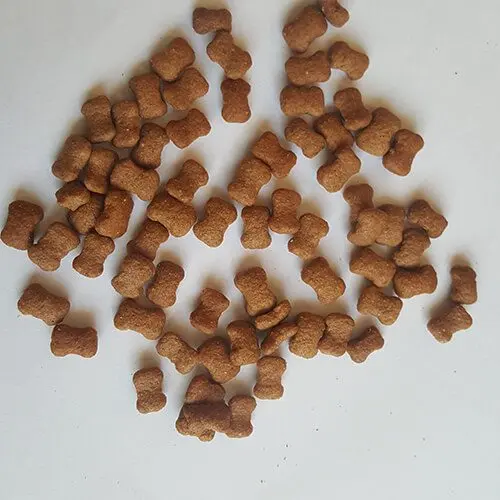
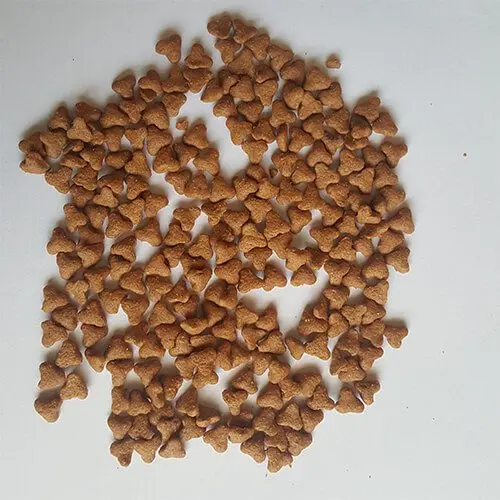
| Final Pellet Shape | bone shape, footprint shape, ball shape, heart shape, moon shape etc |
| Application | pet food, fish feed |
| Used For | cat, dog, fish feed |
Pet Food Production Line Overview
There are two types of pet food production lines, one is a dry pet food manufacturing plant, and the other is a wet type extrusion food production line. The wet type is equipped with a boiler that can continuously provide hot steam. It can produce dog food, cat food and other pets food. The size can be from 0.9-15 mm to feed different pets. This pet food production line adopts high puff degree corn powder cereal as a basic pet food formulation ingredients like supplemented bone meal, meat, protein, vitamins, fiber and other nutrients.
Project Case: Full Stainless Steel Plant Exported to USA
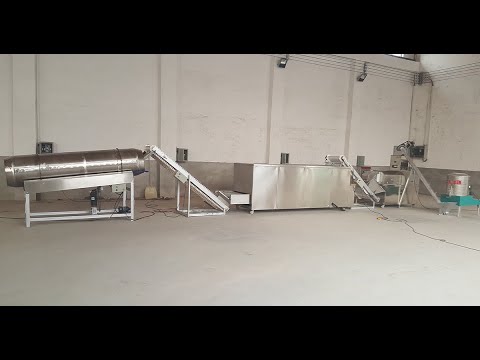
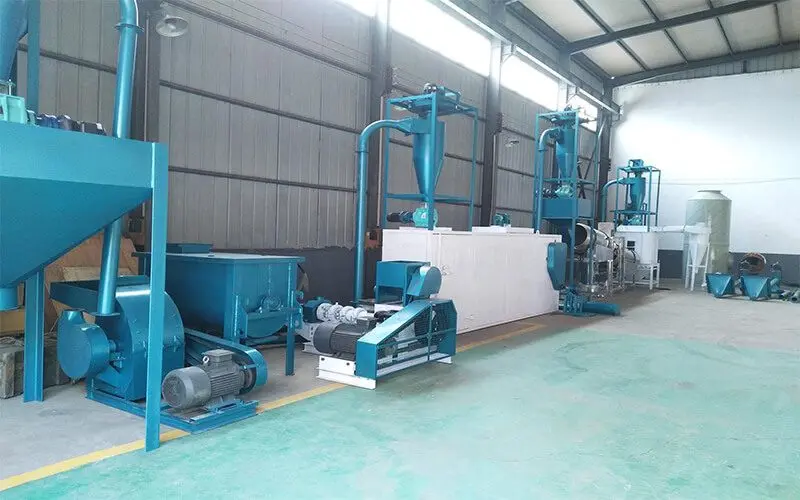
In April, we deliver full complete pet food processing plant to our client from US, he will produce kibble dog food. The whole pet food processing equipment includes conveyor machine, pet food extruder, dryer machine, cooling belt, flavoring device etc, the complete pet food processing plant is fully made of stainless steel.
Advantage of Pet Food Processing Plant
- The main pet food extruder machine adopts frequency speed controlling with high automation and stable performance.
- The screws of the pet food extruder machine are made of stainless steel and special craft, durable usage. Adopt the building block structure, compact and easy operation.
- The forced lubrication system guarantees a longer service time of the food extruder machine transmission system.
- Auto-temperature control system makes the temperature controlling more directly viewed and the parameter more precise.
- The pet food processing plant can be equipped with a heating boiler which can connect to the heating gas, making the grains fully cooked.
- This pet food processing line machinery has wide application for making food pellets with various shapes for fish, dog, cat, and other pet etc.
Pet Food Production Process
♦ Crushing
The raw material ingredients should be crushed to the required particle size by a feed crusher. We supply two types of feed grinders to meet your different requirements: feed Hammer Mill is suitable for small or medium sized feed extruding factories; SPSF feed Hammer mill is used for grinding raw materials by large and medium livestock and aqua feed mills.
♦ Mixing
The mixing process is a key process in pet food production line. The basic process is to weigh the raw materials in different weight according to formula, then pour them in the crusher to decrease size, and later all materials are temporarily stored in the storage silo.
♦ Extruding
Extruding is a heat treatment process with high temperature and in short time. It can not only reduce the degradation of food nutrients, improve the digestibility of protein starch, but also destroy the anti nutrient components and microorganism. All shapes of pet dry food such as round, triangle, flower shape and bone shape can be produced through different molds (templates) of the feed extruder machine. In pet food extrusion process, fat is usually added to improve pet food palatability, and this is carried out in conditioning process.
♦ Drying
The drying section is mainly used for removing water in the extruded pet food. After extrusion, the texture of the material is relatively soft and water content reaches 20~30%. After the drying process, the finished product moisture is controlled at 8%~10%, which can ensure that the material is stored in a certain period of time. Our mesh belt dryer is a continuous convective belt dryer. Pellets formed through the extruder are stacked in layers on a wire mesh or perforated plate belt conveyor and conveyed continuously through drying chambers.
♦ Oil and Fat Spraying
Oil and fat are the best source of energy, so 2%~8% of oil and fat can be added to formula according to pet growth needs. We suggest that the content of the total oil in the extruder be kept within 12%. If the extruded material needs more than 12% oil content, the extra oil is suggested to be added in the way of external spray after drying. It can be used at normal pressure or vacuum coating depending on how much oil is added. In addition to oil, some powdered attractant is also coated to increase pet feed palatability.
♦ Cooling & Sieving
The main purpose of the cooling section is to cool the dried material from high temperature to near room temperature and take away part of the moisture content. Also, in this process, the ineligible food tablets will be separate from eligible ones.
♦ Packaging
With our electronic weighing and packing machine, the finished pellets can be packed into bags, weighed, conveyed, and sealed automatically, which saves labor and time greatly and meet the requirements of large scale production. The conventional weight include: 5kg, 1kg, 500g, 20g, and also 20-50kg large package. For this packing machine, automatic bag sewing and automatic thread cutting can be optional functions.

Industry Trends: Wet vs. Dry Pet Foods
A major trend in packaging for wet pet foods is going to smaller single-serve sizes, which consumers prefer for convenience and less wastage compared to larger containers. Examples of the new smaller sizes include three-oz. and five-and-a-half-oz. cans with peel-off lids. Science Diet dry cat food by Hill’s Pet Nutrition, for instance, comes in a three-and-a-half-lb. plastic pouch with a clever Velcro top strip that’s designed for easy opening and closure.

Automated pet food production plant video