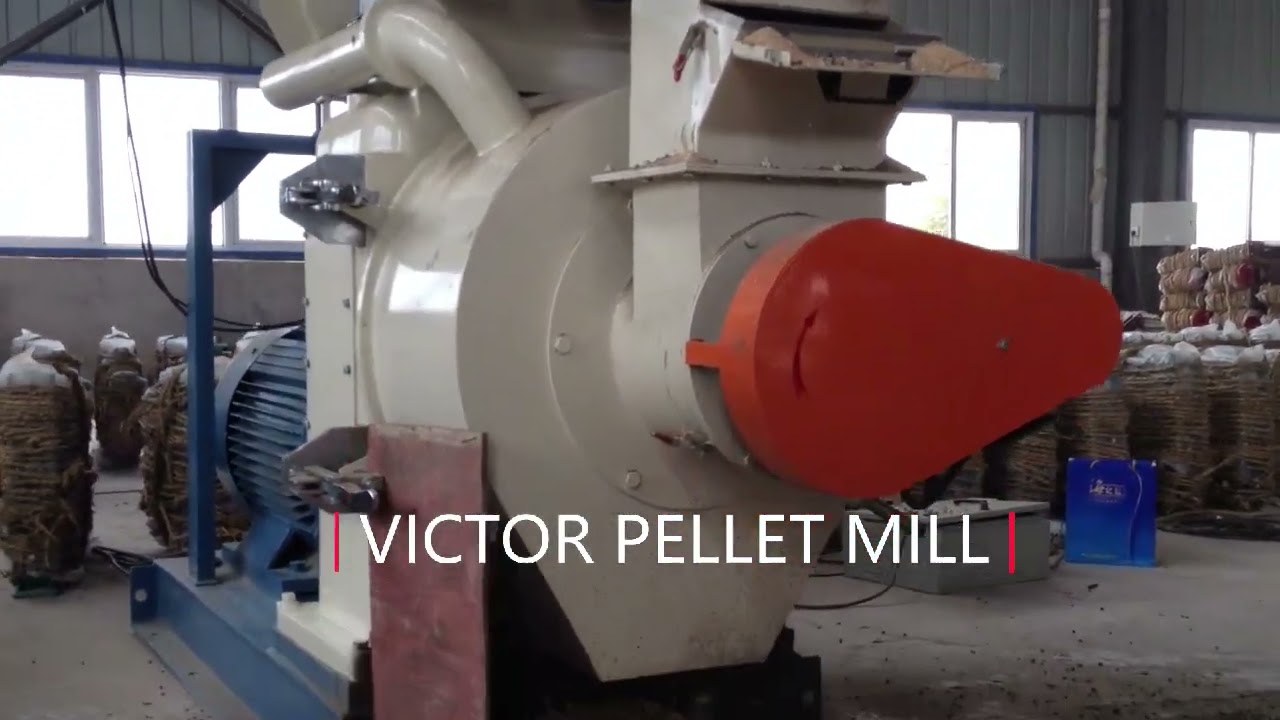

| Model | HMK-350 |
| Capacity | 3-5 tons/h |
| Application | Dairy cattle, beef cattle and commercial feed production |
| Power Type | Electric motor |
| Power | 55 KW Three-phase Motor |
| Feeding Power | 0.75 kw |
| Conditioner Power | 2.2 kw |
| final pellet size | 5-12 mm |
| raw materials | Corn meal, soybean meal, fish meal, alfalfa meal, grass and straw |
| die diameter | 350mm |
Why Produce Cattle Feed Pellets?
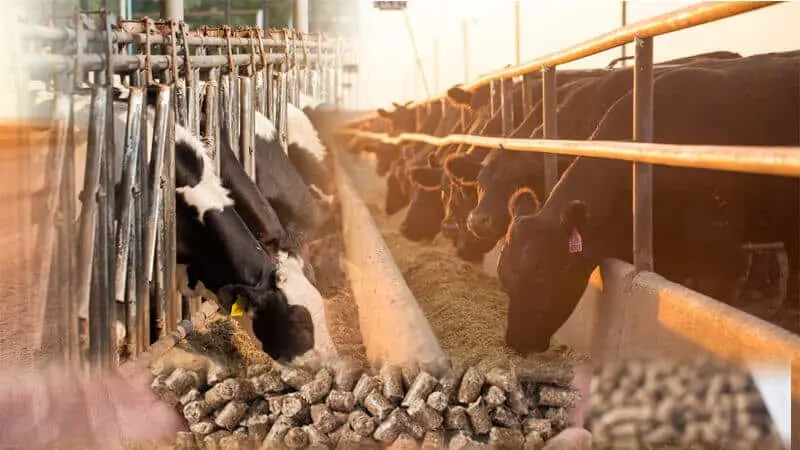
A cattle feed pellet mill converts grains, forage and agricultural by-products into dense and uniform feed pellets.
Main benefits include:
- Reduced feed waste
- Easier storage and transportation
- More consistent feed quality
- Better utilization of agricultural by-products such as straw and grass
Who Needs a Cattle Feed Pellet Mill?
The ring die cattle feed pellet mill is designed for users who require continuous feed production.
Dairy Farms
Dairy farms benefit from consistent pellet size, easier storage and simplified feeding management.
Beef Cattle and Fattening Farms
Suitable for producing balanced feed pellets with convenient storage and feeding management.
Commercial Feed Producers
For feed manufacturers, HMK-350 with 3-5 t/h capacity is suitable for medium-scale commercial feed producers and livestock feed plants requiring stable daily output.
Features of Cattle Feed Pellet Mill
High Capacity Continuous Production
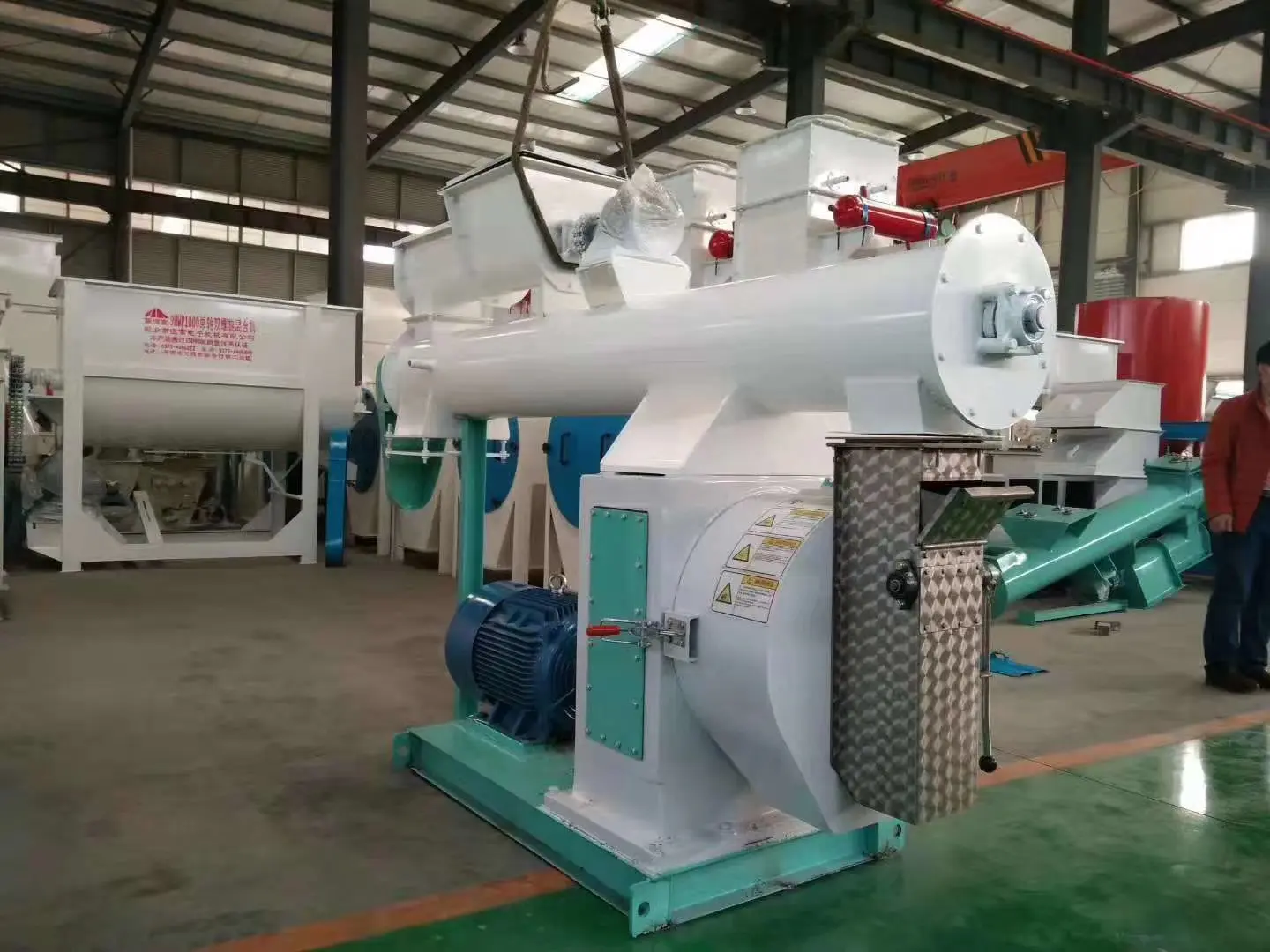
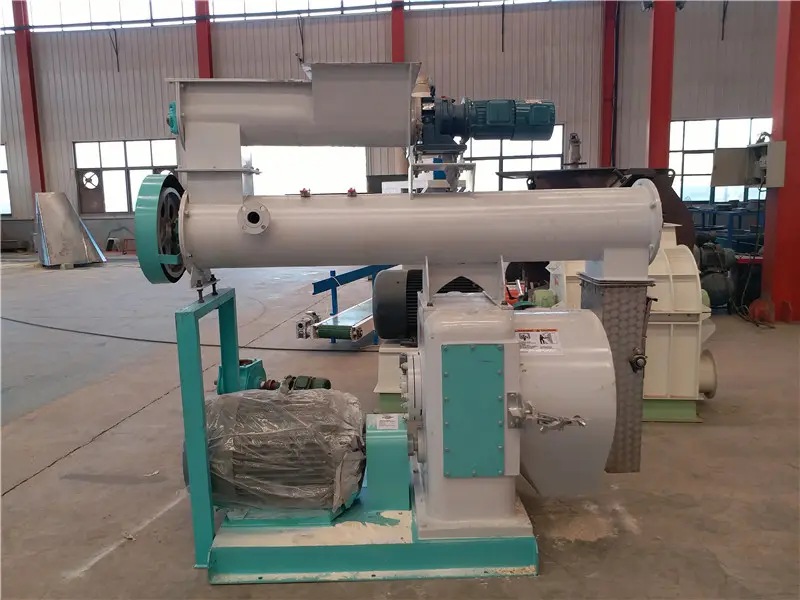
The HMK-350 ring die cattle feed pellet mill provides 3-5 t/h production capacity, making it suitable for medium-scale livestock farms, commercial feed producers and feed processing plants. Its ring die structure is designed for stable continuous operation with consistent pellet quality.
Adjustable Feeding System
The adjustable feeding system with inverter control allows operators to regulate material flow according to different raw materials and production requirements, ensuring stable pelletizing performance.
Single and Double Conditioner Options
Single or double conditioner options are available according to different feed formulations. Double conditioner systems are recommended for high-fiber materials such as alfalfa, grass and straw.
Advanced Conditioner System
The conditioner improves moisture and heat mixing before pelletizing, helping produce stronger and more uniform feed pellets. Food-grade stainless steel components are available for applications requiring higher hygiene standards. The conditioner can be equipped with stainless steel paddles and shaft to improve durability and maintain stable conditioning performance.
Durable Ring Die and Roller System
The ring die and rollers are made of alloy steel with heat treatment, improving wear resistance and extending service life during continuous feed production.
Automatic Lubrication System
The automatic grease lubrication system reduces manual maintenance requirements and improves long-term operating reliability.
Stable Transmission System
The transmission system provides stable power transfer and high torque output, ensuring reliable operation during continuous cattle feed pellet production.
Why Choose Ring Die Technology for Cattle Feed Production?
The HMK-350 ring die cattle feed pellet mill is designed for continuous medium-scale feed production. Ring die cattle feed pellet mills are especially suitable for processing fibrous cattle feed materials such as alfalfa, grass and straw. Proper grinding, mixing and conditioning help improve pellet formation and production stability when processing high-fiber formulas.
Compared with flat die pellet mills, ring die pellet mill technology provides higher production capacity and more stable operation, making it suitable for dairy farms, beef farms and commercial feed manufacturers.
The ring die pellet mill adopts a vertical-axis ring die and roller structure. The rollers rotate inside the ring die, and their inner and outer edges maintain the same travel distance across the die surface. This design reduces roller skipping, improves pressure distribution and helps extend die service life compared with flat die pellet mills.
Ring Die Pellet Mill vs Flat Die Pellet Mill
| Comparison | Ring Die Pellet Mill | Flat Die Pellet Mill |
|---|---|---|
| Production Capacity | 3-5 t/h | Usually below 1 t/h |
| Working Mode | Continuous production for large-scale feed manufacturing | Batch or small-scale production |
| Application | Commercial cattle farms, livestock farms and feed production plants | Small farms, household use and small feed production |
| Production Efficiency | Higher output efficiency and suitable for long-term operation | Lower output, suitable for flexible small-scale production |
| Initial Investment | Higher initial investment due to larger capacity and complete structure | Lower investment cost and easier entry for small users |
| Recommended Users | Medium and large farms, commercial feed producers | Small farms and individual users |
Complete Cattle Feed Pellet Production Line
The HMK-350 can be configured as the core machine of a complete 3-5 t/h cattle feed production line. A complete cattle feed pellet production line usually includes:
- Hammer mill for raw material grinding
- Feed mixer for ingredient blending
- Conditioner for moisture and temperature control
- Ring die pellet mill for pellet formation
- Pellet cooler for temperature reduction
- Screening machine for removing fines
- Packing machine for final packaging
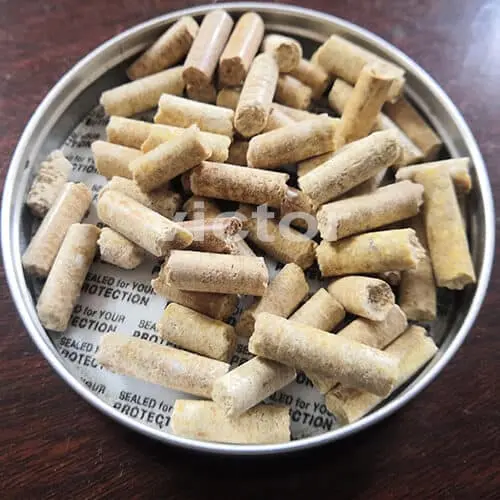
Raw Material and Feed Requirements for Cattle Feed Pellet Mill
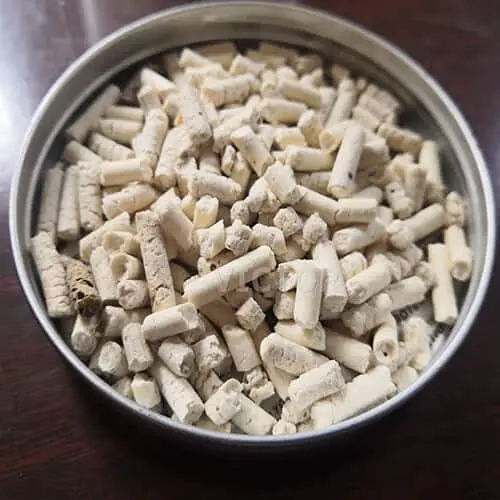
The HMK-350 cattle feed pellet mill is designed to process various cattle feed materials, including corn meal, soybean meal, alfalfa meal, grass meal and agricultural by-products. Before pelletizing, raw materials should be properly prepared through grinding and mixing to ensure stable pellet formation and consistent feed quality.
During production, raw materials are ground, mixed and conditioned before pelletizing, helping achieve stable pellet formation and consistent feed quality.
Recommended Cattle Feed Pellet Sizes
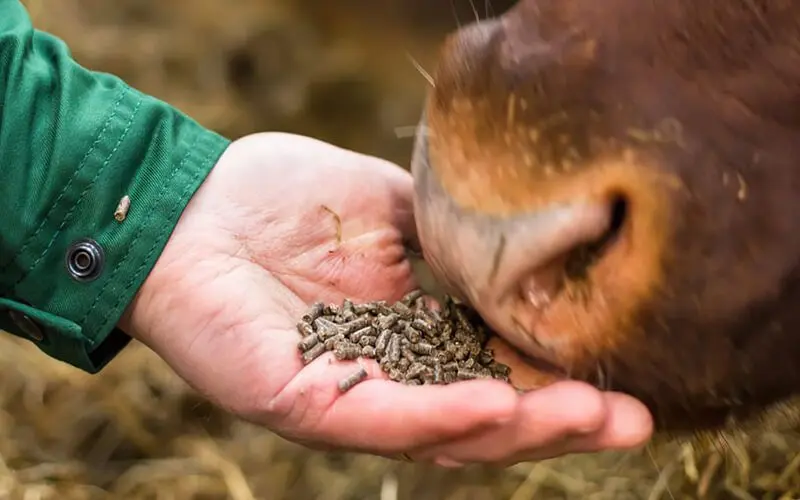
The pellet size for cattle feed depends on animal type, cattle feed formulation and feeding requirements. Common pellet sizes for different cattle applications include:
| Animal Type | Recommended Pellet Size |
|---|---|
| Calves | 3-5 mm |
| Dairy cattle | 5-8 mm |
| Beef cattle | 6-10 mm |
| Fattening cattle | 8-12 mm |
For commercial cattle feed production, pellet size can be customized by selecting different die hole diameters according to customer requirements.
Cattle Feed Pellet Mill Maintenance
Regular maintenance helps maintain pellet quality and extend equipment service life.
- Lubricate bearings
- Check die and rollers
- Clean feeding system
- Inspect gearbox oil
- Replace worn parts
Specification of Cattle Feed Pellet Mill
| Model | Power(Kw) | Output(kg/h) | Feeding Power(kw) | Conditioner Power(kw) | Ring Die Diameter(mm) | Pellet Size(mm) |
| HMK-250 | 22 | 500-1000 | 0.55 | 2.2 | 250 | 5-12 |
| HMK-300 | 30 | 1000-2000 | 0.75 | 2.2 | 300 | 5-12 |
| HMK-320 | 37 | 2000-3000 | 0.75 | 2.2 | 320 | 5-12 |
| HMK-350 | 55 | 3000-5000 | 0.75 | 2.2 | 350 | 5-12 |
| HMK-400 | 75 | 5000-8000 | 1.5 | 5.5 | 400 | 5-12 |
| HMK-420 | 110 | 8000-10000 | 1.5/2.2 | 5.5 | 420 | 5-12 |
How to Choose the Right Cattle Feed Pellet Mill Model?
Choose the machine according to your required daily feed output.
| Required Capacity | Recommended Model | Suitable Application |
|---|---|---|
| 0.5–1 t/h | HMK-250 | Small dairy farms and small commercial feed production |
| 1–2 t/h | HMK-300 | Medium-sized cattle farms |
| 2–3 t/h | HMK-320 | Commercial livestock farms requiring continuous production |
| 3–5 t/h | HMK-350 | Medium-scale cattle feed production |
| 5–8 t/h | HMK-400 | Large cattle farms and feed processing plants |
| 8–10 t/h | HMK-420 | Large-scale commercial feed production |
Selection Tip:
Before choosing a cattle feed pellet mill, consider your daily feed demand, available raw materials, required pellet size, electricity supply and future production expansion plans. For farms with higher output requirements, a ring die cattle feed pellet mill provides better efficiency and stability for continuous operation. For small-scale feed production, see our Animal Feed Making Machine.
Video of Cattle Feed Pellet Machine