
Identifying Your Feed Type and Nutritional Requirements
No matter small poultry feed machine, or commercial chicken production line, this technology has changed the way that farmers deal with nutrition and feed quality.
It is essential and important to make different feeds for different stages of poultry like chicks, layers, broilers. You should consider to choose a chicken feed making machine which can deal with a various ingredients and maintain optimal feed nutrition and quality. Before selecting machinery, you must define the physical shape of the feed you intend to produce:
- Mash/Powder Feed: Made using a hammer mill and mixer. It is cheap to produce but leads to 6%–10% feed waste due to selective eating by the poultry.
- Pelleted Feed: Made by compressing mash under high heat and pressure. It improves nutrient utilization, destroys toxic components, and reduces feed waste by 8%–10%.
- Crumble Feed: Pellets that are mechanically crushed down to 2–4mm. Ideal for slowing down eating speeds while maintaining pellet benefits.
To match the biological requirements of poultry, the machine must produce specific pellet diameters:
- 2.0mm – 2.5mm for Chicks Feed: Best for chicks which can ensure them to swallow easily and 100% nutrient intake.
- 3.0mm – 4.5mm for Grower Feed: Best for broilers which can balance intake speed and energy density.
- Layer/Finisher Feed (4.5mm – 6.0mm): For adult poultry, providing structural integrity for calcium and protein retention.
Scale of Production and Technical Selection
Are you a free-range poultry farmer or a large scale commercial farmer? Your scale determines the type and size of chicken feed maker machine you need.
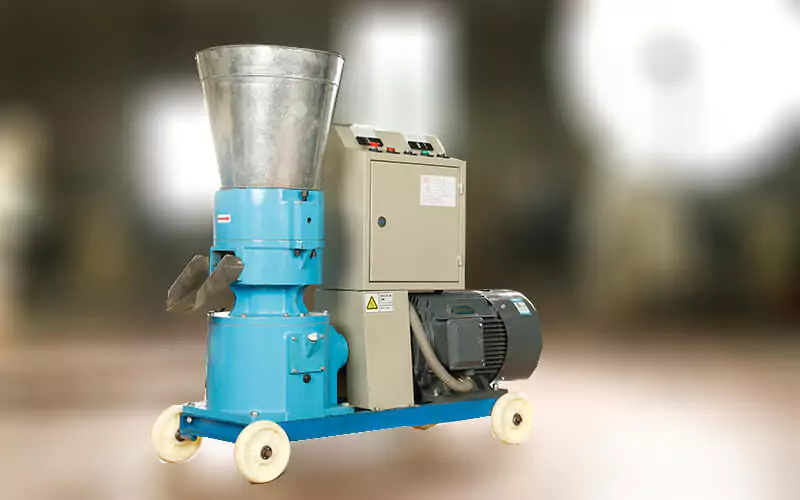
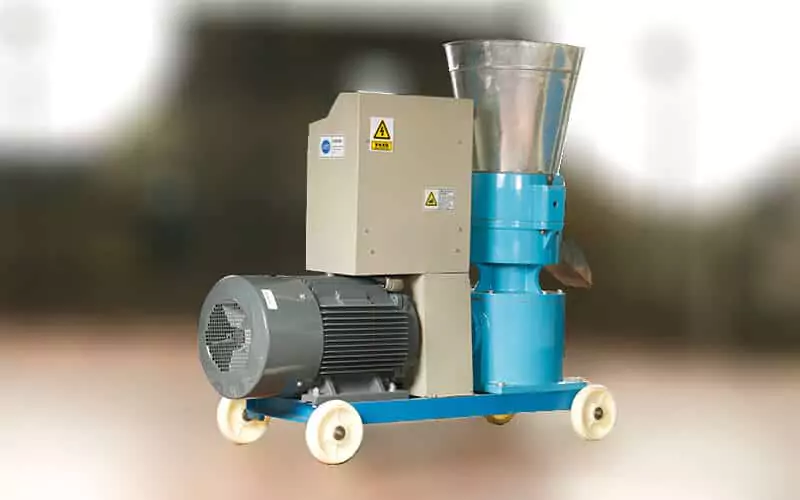
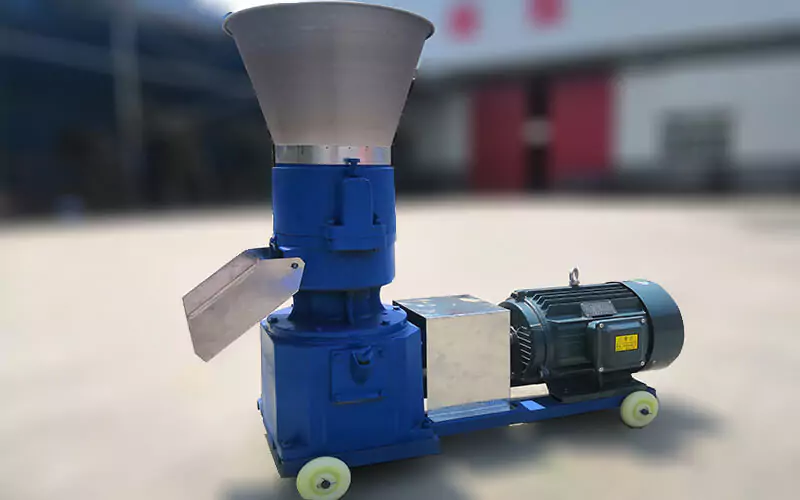
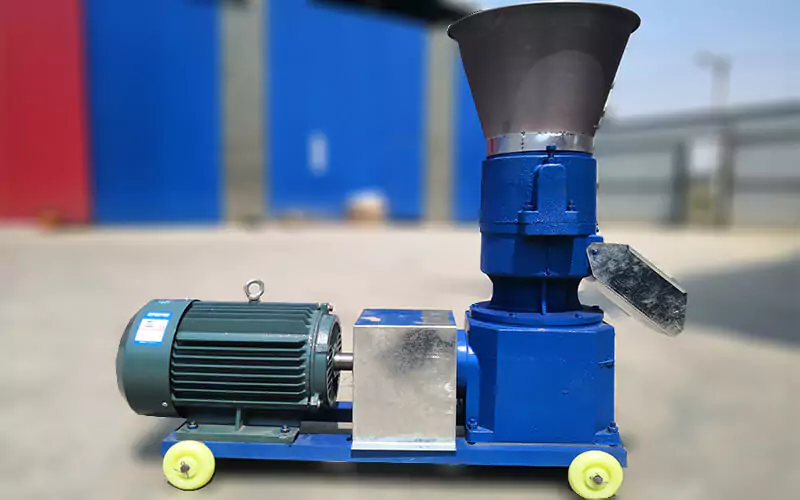
- Small Scale (100-800 kg/h): Usually adopts Flat Die Chicken Feed Pellet Machine. It features a compact structure and is ideal for home use or small farms utilizing 4kW to 22kW electric motors or diesel engines.
- Commercial Scale (1-15 t/h): Requires a Ring Die Chicken Feed Production Line. These industrial systems utilize high-precision gear drive mechanics and multi-layer conditioners to ensure continuous 24/7 operation with high throughput.
Comparison: Flat Die vs. Ring Die Pellet Machine
| Feature | Flat Die Pellet Machine | Ring Die Pellet Machine |
| Die Design | Horizontal flat disk with rollers | Vertical circular ring with inner rollers |
| Production Capacity | 50 kg/h to 3 tons/h | 1 ton/h to 20 tons/h |
| Target User | Home use, family farms, pilot production | Commercial feed mills, large industrial farms |
| Initial Investment | Low (Starting around $490) | High (Starting around $15,600) |
| Power Options | Electric, Diesel, Gasoline, PTO | Primarily 3-Phase Electric |
| Maintenance | Simple, cheap, and easy to clean | More complex, requires specialized care |
The Complete Feed Production Workflow
A successful chicken feed plant requires more than just a pellet machine; it requires a streamlined workflow to ensure pellet durability and biosecurity:
- Pre-treatment (Crushing & Mixing): Raw materials (like corn, wheat, and soybean meal) must be ground to a uniform powder.
- Conditioning & Pelletizing: For commercial setups, steam conditioning (85°C–95°C) is used to achieve starch gelatinization and eliminate pathogens like Salmonella. The raw material moisture must be strictly controlled between 12% and 15%.
- Cooling: Fresh pellets exit the machine at 70°C–90°C. They must be immediately cooled using a counterflow cooler to drop the temperature to below 35°C and reduce moisture to under 12%, preventing mold and breakage.
- Screening & Packaging: Defective pellets and dust are screened out and recycled. Finished pellets are packaged in moisture-proof bags to extend shelf life.
Technical Specifications of Chicken Feed Pellet Mill
| Model | Power (kW) | Capacity (kg/h) | Die Diameter (mm) | Pellet Size (mm) |
| VTKLP-150 | 4 | 100-150 | 150 | 2.0 – 8.0 |
| VTKLP-230 | 11 | 300-500 | 230 | 2.0 – 8.0 |
| HMKL-350 (Ring Die) | 55 | 3000-5000 | 350 | 2.0 – 10.0 |
| HMKL-420 (Ring Die) | 110 | 8000-12000 | 420 | 2.0 – 12.0 |
Budget Considerations and The Benefits for Poultry Farmers
poultry feed machine ranges from afforable small options to high-technology business solutions. Choosing adaptable chicken feed production equipment machine to achieve your agricultural and finacial goals with balance quality, functionality and cost improvement.
Choosing a cost-effective machine goes beyond the upfront price tag. You must evaluate the Total Cost of Ownership (TCO) over a 1 to 3 year period, considering factors like energy consumption, labor costs, and wear and tear on consumable parts (die and rollers).
Investing in the right chicken feed making machine enhances:
- Nutritional Quality: Customized recipes lead to healthier poultry with balanced amino acid profiles.
- Production Flexibility: Cater to different poultry stages with ease by quickly changing the die molds.
