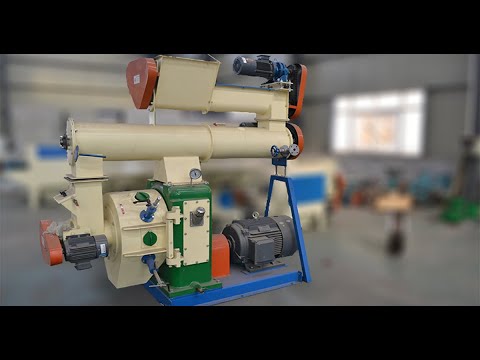

| Model | HMK-320 |
| Capacity | 2000-3000 kg/h |
| Power Type | Electric Motor (3-Phase) |
| Main Power | 37 KW three phases |
| Feeding Power | 0.75 kw |
| Conditioner Power | 2.2 kw |
| Ring Die Diameter | 320 mm |
| Raw Materials | Cereal, corn, wheat, barley flour, soybean, oilseed meal/cake, edible leaf, fish meal, bone powder, etc. |
| Feed Type | Sinking fish feed |
| Final Pellet Size | 1.5mm – 5.0mm (Adjustable) |
| Application | Sinking fish feed production |
Sinking Fish Feed Pellet Mill for Commercial Production
This ring die sinking fish feed pellet mill is designed for commercial production of dense sinking aquatic feed pellets. Compared with small flat-die pellet machines, ring die pellet mills are suitable for higher-capacity production. Final pellet quality depends on feed formulation, grinding, conditioning, moisture and pelletizing conditions.
The machine is mainly used for sinking fish feed production and can also be configured for other aquatic feed applications such as shrimp feed. Learn more about the sinking fish feed production process.
For production requirements above the capacity of a single pellet mill, multiple units can be installed in parallel to form a larger-capacity production system. For floating fish feed applications, see our floating fish feed machine.

Why Use a Ring Die Pellet Mill for Sinking Fish Feed?
Ring die pellet mills use a vertical die and roller structure to compress feed materials through die holes and form uniform pellets. Compared with flat die pellet mills, the rollers and die maintain consistent movement during operation, which helps reduce roller slip and provides more stable pelletizing performance for commercial aquatic feed production.
The HMK series covers production capacities from 0.5 to 10 t/h. For larger production requirements, multiple ring die pellet mills can be installed in parallel to achieve higher-capacity feed production systems.
The main drive uses gear transmission for stable power transfer, while the drive and roller arrangement supports continuous operation and consistent compression during pelletizing. The ring die and roller structure also helps distribute wear more evenly during operation, which can reduce maintenance requirements.


Sinking Fish Feed Machine Features
- Advanced Conditioning System: The sinking fish feed machine can be equipped with a three-layer conditioner for controlled mixing, moisture addition and residence time before pelletizing. Contact components can use 304 stainless steel depending on the selected configuration.
- Smart Feeding Mechanism: The feeding system uses a controlled material flow to deliver conditioned feed material into the pelletizing chamber. A screw feeder can be used to regulate the feed rate and maintain consistent feeding during operation.
- High-Precision Gear Transmission: The gear transmission system provides stable power transfer during continuous pelletizing operation.
- Premium Components: Depending on the final configuration, the machine can be supplied with selected branded bearings, oil seals, inverters and PLC control components. Component brands and specifications should be confirmed in the final quotation.
- Automatic Lubrication System: The automatic lubrication system is designed to support continuous operation and routine maintenance. The main shaft lubrication arrangement allows maintenance without unnecessary production interruptions, depending on the machine configuration.


How to Choose the Right Machine for Sinking Fish Feed?
- 0.5 – 1.0 t/h (Small Commercial Production): HMK-250 is the smallest model with a compact structure, suitable for small fish farms and feed factories requiring commercial sinking fish feed production.
- 2.0 – 5.0 t/h (Commercial Scale): HMK-320 and HMK-350 are commonly selected for commercial sinking fish feed production with medium production requirements.
- 8.0 – 10.0 t/h (Industrial Grade): HMK-420 is designed for higher-capacity sinking fish feed production in the 8–10 t/h range. Its reinforced drive system is configured for continuous-duty operation.
Sinking Fish Feed Pellet Mill Price
The price of a sinking fish feed pellet mill depends on production capacity, pellet size, motor configuration, conditioner configuration and automation requirements. Different HMK models are available for different production requirements. Contact us with your target capacity and pellet specification for a factory quotation.
Sinking Fish Feed Pellet Machine Specifications
| Model | Main Power(Kw) | Capacity(kg/h) | Feeding Power(kw) | Conditioner Power(kw) | Ring Die Diameter(mm) | Pellet Size(mm) |
| HMK-250 | 22 | 500-1000 | 0.55 | 2.2 | 250 | 1.5-5 |
| HMK-300 | 30 | 1000-2000 | 0.75 | 2.2 | 300 | 1.5-5 |
| HMK-320 | 37 | 2000-3000 | 0.75 | 2.2 | 320 | 1.5-5 |
| HMK-350 | 55 | 3000-5000 | 1.5 | 3 | 350 | 1.5-5 |
| HMK-400 | 75 | 5000-8000 | 1.5 | 5.5 | 400 | 1.5-5 |
| HMK-420 | 110 | 8000-10000 | 1.5/2.2 | 5.5 | 420 | 1.5-5 |
Sinking Fish Feed Pellet Mill Working Video
Watch the working video to see the ring die pellet mill producing sinking fish feed pellets.